

Most beginners lose money in Crash and Boom markets not because they lack indicators, but because they don’t understand what they’re looking at.
You’ve probably seen the wild price spikes. Maybe you’ve even chased them. The markets move fast, patterns seem random, and every YouTube guru promises a “secret” strategy that guarantees profits. Here’s the uncomfortable truth: indicators don’t predict the future—they help you read the present clearly.
This guide breaks down the five most practical MT5 indicators for deriv trading beginners. More importantly, it shows you how to interpret them so you can avoid the costly mistakes that trap new traders.
Understanding Crash and Boom Markets

Crash and Boom are synthetic indices that simulate market behavior with predictable patterns of extreme volatility.
Unlike traditional forex or stock markets, these indices are programmed with specific spike frequencies. The Crash 1000 market, for example, experiences a sudden downward crash approximately once every 1,000 ticks. Similarly, Boom 1000 produces upward spikes at similar intervals.
The variants—150, 300, 500, and 1000—represent how frequently these dramatic price movements occur. Lower numbers mean more frequent spikes; higher numbers mean longer periods of trending before the inevitable spike hits.
This predictability creates unique opportunities. But it also creates a false sense of security. Knowing a spike will happen doesn’t tell you when—and that’s where indicators become essential reading tools, not crystal balls.
Why Deriv Created These Synthetic Indices

Deriv has operated as a regulated broker since 1999, making it one of the longest-standing online trading platforms [Deriv Official].
Synthetic indices were designed to solve a specific problem: providing 24/7 trading opportunities independent of real-world market hours or economic events. Traditional markets close on weekends; Crash and Boom never sleep.
The unique spike behavior wasn’t just a gimmick. It was engineered to create markets where technical analysis actually matters more than fundamental analysis. There are no earnings reports, no central bank decisions, no geopolitical shocks—just price action and patterns.
This democratized trading for beginners who felt overwhelmed by tracking global news. But it also created a dangerous illusion: that these markets are “easier” because they’re simpler. They’re not easier. They’re just different.
The popularity of Crash and Boom exploded particularly in emerging markets where traders wanted alternatives to traditional forex pairs. The guaranteed volatility attracted risk-takers. The 24/7 availability attracted part-time traders. The result? A massive community of retail traders—many of whom learned expensive lessons about the difference between having indicators and understanding them.
Five Essential Indicators for Beginners
1. Moving Averages (MA): Your Trend Compass

The Moving Average is the single most important tool in your deriv mt5 arsenal.
Think of it as a smoothing filter that cuts through market noise. While price jumps around erratically, the MA shows you the underlying direction—is the market trending up, down, or sideways?
There are two main types: Simple Moving Average (SMA) and Exponential Moving Average (EMA). The SMA treats all price points equally; the EMA gives more weight to recent prices.
Here’s what matters: you can build over 100 trading strategies by adjusting just three MA parameters—the period length, the type, and the price it calculates from [Author’s experience]. A 20-period EMA reacts faster than a 200-period SMA. Fast MAs help you catch trends early; slow MAs help you filter out false signals.
For Crash and Boom specifically, traders often use dual-MA setups: when a faster MA crosses above a slower one, it suggests upward momentum. When it crosses below, momentum is shifting down.
2. RSI (Relative Strength Index): The Divergence Detector
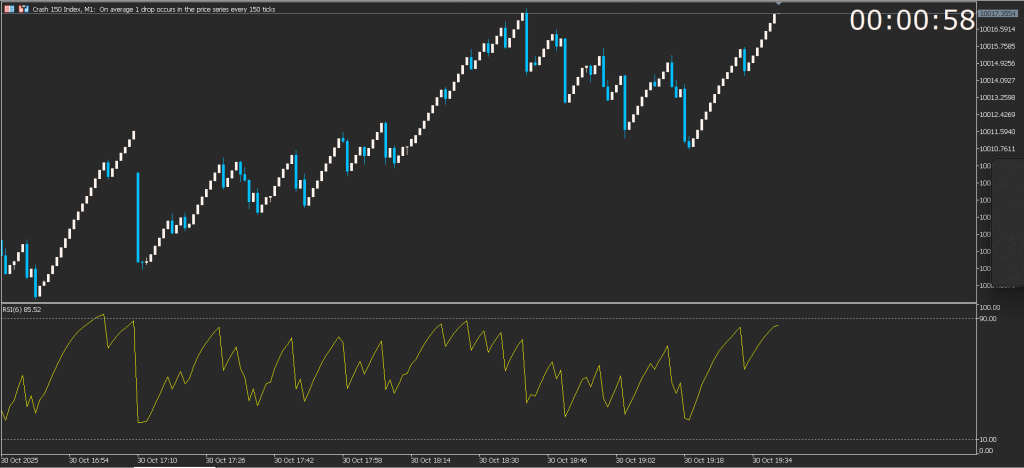
RSI measures momentum by comparing recent gains to recent losses on a scale of 0 to 100.
The traditional interpretation is simple: above 70 means “overbought,” below 30 means “oversold.” But in Crash and Boom markets, this basic reading is nearly useless. These markets can stay overbought or oversold for extended periods before a spike hits.
The real power of RSI lies in divergence patterns. This is when price moves in one direction but RSI moves in the opposite direction—a signal that momentum is weakening and a reversal might be coming.
Divergence is genuinely difficult for beginners to spot and interpret. It requires practice and patience. Consider marking “RSI Divergence” as a future learning topic and returning to it after you’re comfortable with basic trend reading.
3. Combining RSI + Moving Averages: The Reliable Setup
Individually, these tools are useful. Together, they become powerful.
A common intermediate strategy: use the MA to identify the trend direction, then use RSI to time your entry within that trend. If the MA shows an uptrend and RSI dips into oversold territory without breaking the trend, that’s a potential buying opportunity during a temporary pullback.
This RSI + MA combination works especially well for identifying trend continuation versus reversal zones. It’s not foolproof, but it’s reliable enough that many experienced traders use variations of it as their core strategy.
One trader reported using RSI + Moving Averages + custom Imbalance Ratings from 2022 to 2024, eventually developing personalized tools to overcome the inherent lag in standard indicators [Author’s experience].
4. Bollinger Bands: The Volatility Reader
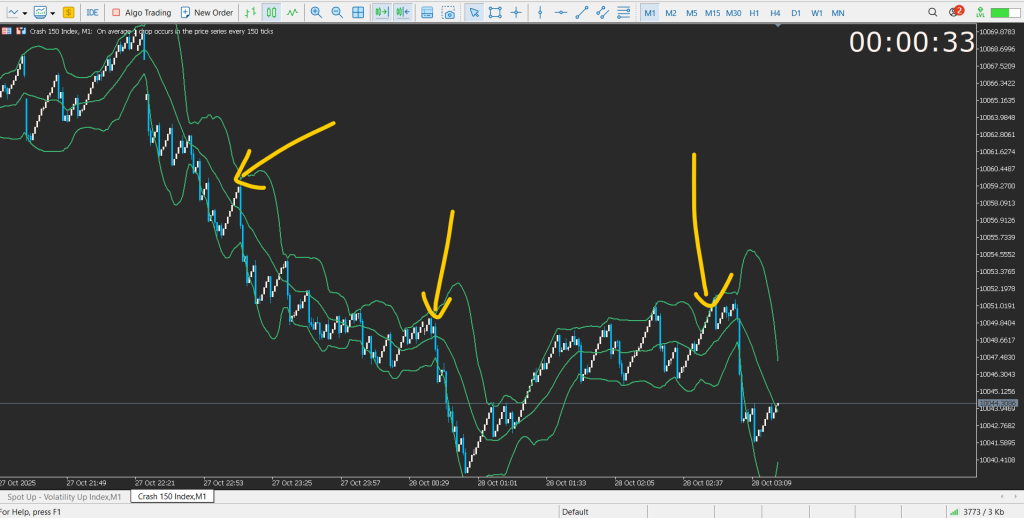
Bollinger Bands use standard deviation to create dynamic support and resistance levels around a moving average.
The structure looks like a funnel that expands and contracts. When the bands widen, volatility is increasing. When they narrow (called a “squeeze”), volatility is decreasing—often preceding a major price movement.
In Crash and Boom markets, Bollinger Bands help you identify when price is compressed and likely to break out versus when it’s already extended and due for a pause. The bands themselves aren’t triggers—they’re context.
Using MQL (MetaQuotes Language) on the deriv mt5 platform, advanced traders can build custom tools that analyze Bollinger Band behavior more precisely. But the basic indicator is sufficient for beginners.
5. Custom Indicators: The Advanced Path
Standard indicators are lagging—they calculate based on past price data, so they’re always telling you what already happened.
Some traders develop custom indicators to analyze real-time market data more responsively. These tools often combine multiple standard indicators with proprietary logic to reduce lag or identify patterns the naked eye might miss.
Custom indicators are available through various developers, including some specific to Deriv trading communities. Access often requires registration and proof of account ownership [Author’s experience].
Important caveat: Custom tools don’t extract “secret information” from brokers. They’re just more sophisticated ways of interpreting the same publicly available price data. Don’t overcomplicate your approach chasing the latest “secret weapon.”
Why Indicators Aren’t Guarantees
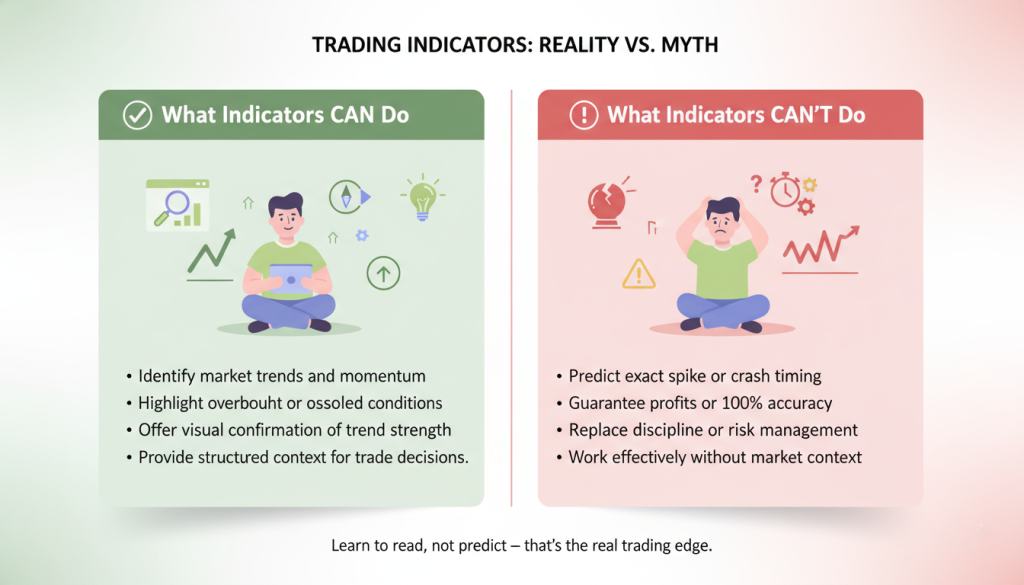
Here’s the hard part: indicators don’t predict spikes or guarantee winning trades.
They’re reading tools, not fortune-telling devices. Even the most sophisticated combination of RSI, Moving Averages, and Bollinger Bands can’t tell you the exact moment a Crash 500 will spike or a Boom 1000 will surge.
The lagging nature of indicators means you’re always making decisions based on slightly old information. By the time your 20-period MA updates, 20 ticks have already passed. In fast-moving Crash and Boom markets, that lag can be the difference between profit and loss.
Additionally, indicators work best when you already understand market conditions. If you don’t know whether the market is trending or ranging, RSI readings become ambiguous. If you can’t identify support and resistance zones manually, Bollinger Bands won’t magically reveal them.
The biggest complication? Overreliance leads to hesitation. Beginners often freeze when indicators give conflicting signals—the MA says buy, RSI says wait, Bollinger Bands say volatility is decreasing. Analysis paralysis sets in, and opportunities pass.
How Proper Indicator Use Affects Outcomes
Understanding indicators doesn’t guarantee profits, but it significantly reduces catastrophic losses.
The most immediate impact: you learn when NOT to trade. Many beginners blow their accounts trying to trade choppy, sideways markets where neither trends nor reversals are clear. Indicators help you identify these low-probability conditions and step aside.
Even basic knowledge of one or two indicators can help you avoid bad trading days. When Moving Averages are flat and tangled, the market is confused—that’s your signal to wait. When RSI is hovering around 50 with no clear divergence, momentum is neutral—that’s not your opportunity [Author’s experience].
Traders who use indicators as filtering tools rather than entry signals tend to take fewer trades but with higher quality setups. This shift from quantity to quality compounds over time, protecting capital and building consistency.
“Having indicators alone doesn’t guarantee success. The real value is in understanding how to use them.” [Author’s experience]
Your Action Plan
If you’re new to deriv trading, start with the Moving Average.
Actionable steps:
- Week 1: Add a 20-period EMA to your chart. Just watch. Don’t trade yet. Notice when price stays above it (uptrend) and below it (downtrend).
- Week 2: Add RSI. Watch for divergence between RSI direction and price direction. Still don’t trade—just observe and take notes.
- Week 3: Combine both. Look for opportunities where the MA shows a clear trend AND RSI confirms momentum in that direction.
- Week 4: Add Bollinger Bands. Notice the difference between high-volatility and low-volatility periods.
The key insight: Indicators help you identify context, not entries. They answer “Should I be trading right now?” before you ever ask “Where should I enter?”
Most importantly, don’t collect indicators like Pokémon. Master one before adding another. The trader who deeply understands Moving Averages will outperform the beginner with fifteen indicators they barely comprehend.
If you don’t have a Deriv account yet, register and start practicing on a demo account. Real money should only enter the equation after you can consistently identify market conditions using these tools.
Key Takeaways
The difference between profitable traders and perpetual losers isn’t secret indicators or hidden strategies.
It’s patience. It’s discipline. It’s the willingness to sit out when indicators say “this isn’t your setup.” Master these five tools not as prediction machines but as reading comprehension aids, and you’ll avoid the mistakes that drain most beginners’ accounts.
Remember:
- Deriv has operated as a regulated broker since 1999, offering 24/7 synthetic indices including Crash and Boom markets
- Crash and Boom variants (150, 300, 500, 1000) differ by spike frequency—lower numbers mean more frequent dramatic price movements
- Standard indicators like MA and RSI are lagging tools—they analyze past data, so they can’t predict future spikes but help identify current market context
What market condition are you seeing on your Deriv charts right now?
Frequently Asked Questions
Q: Can I trade Crash and Boom markets without using any indicators?
Yes, but indicators significantly improve your ability to read market context. Price action alone works for experienced traders, but beginners benefit from the structure indicators provide in identifying trends, momentum, and volatility conditions.
Q: Which single indicator should I learn first for deriv trading?
Start with the Moving Average. It’s the foundation for understanding trend direction. Master how price interacts with a single MA line before adding complexity with RSI, Bollinger Bands, or multi-indicator strategies.
Q: Do custom indicators really make a difference in Crash Boom trading?
Custom indicators can reduce lag and provide more responsive signals, but they’re not magic. The majority of successful traders use standard indicators with disciplined interpretation. Focus on mastering basics before exploring custom tools.
Q: How do I know if the market is too choppy to trade?
Watch your Moving Averages. When multiple MAs are tangled together and frequently crossing with no clear direction, the market is ranging. Flat RSI around 50 and narrow Bollinger Bands confirm low-probability conditions—that’s your signal to wait.
Q: Can indicators predict when a Crash or Boom spike will occur?
No. Indicators cannot predict exact spike timing. They help you understand current market context—whether momentum is building, trends are established, or conditions are unclear. Use them to identify favorable environments, not specific spike moments.


