

You’ve traded EUR/USD during London sessions and watched USD/JPY through Tokyo hours. But what happens when the forex market closes for the weekend and your analysis screams “opportunity”?
Enter synthetic indices: computer-generated markets that never sleep, never react to central bank announcements, and offer price action 24/7/365. Deriv, a multi-regulated broker, has built an entire ecosystem around these algorithmic instruments—with Crash & Boom indices leading the pack. But how do markets without underlying assets actually function? And can retail traders genuinely profit from mathematically generated volatility?
This guide deconstructs the mechanics, reveals the strategic framework, and delivers actionable steps for trading Deriv synthetic indices responsibly.
What Synthetic Indices Actually Are
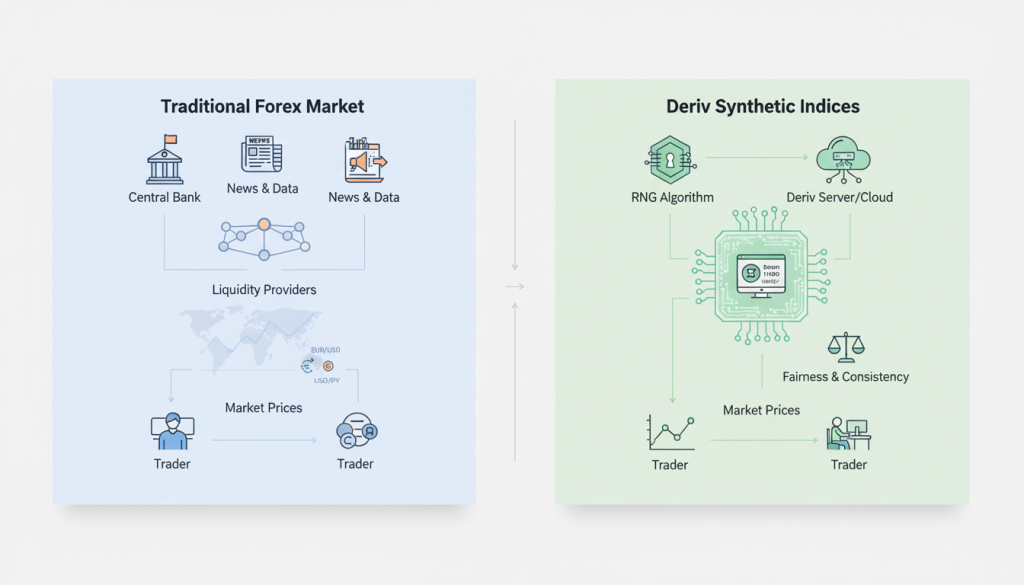
Deriv synthetic indices are simulated financial instruments generated by a cryptographically secure random number generator (RNG) [Deriv]. Unlike forex pairs tied to economic data or stocks linked to corporate performance, these markets exist purely as algorithmic constructs. The RNG produces price ticks independently of real-world events—no FOMC meetings, no earnings reports, no geopolitical shocks.
The Crash & Boom families form the core offering. Crash indices simulate markets with predictable downward spikes (every 500, 1000, or 300 ticks on average), while Boom indices mirror this with upward spikes [Deriv]. Other families include:
- Volatility indices (constant volatility percentages: 10%, 25%, 50%, 75%, 100%)
- Step indices (guaranteed price movements in fixed increments)
- Jump indices (sudden directional leaps at intervals)
- Range Break and Hybrid indices (boundary-breaking mechanics)
Each tick is verifiably random and auditable. The RNG algorithm ensures mathematical fairness—no human intervention, no pattern manipulation. This cryptographic foundation separates synthetic indices from traditional markets where order flow and liquidity gaps create unpredictability.
Why Synthetic Indices Exist
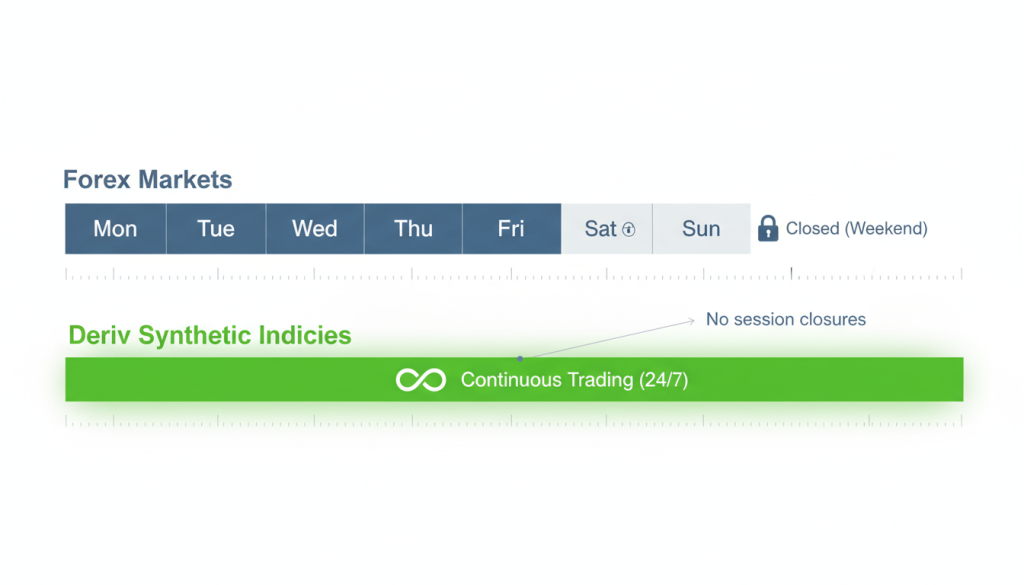
Deriv launched synthetic indices to solve three trader pain points:
- Market closure gaps: Traditional forex operates Monday–Friday. Synthetic indices trade continuously, including weekends and holidays [Deriv].
- News-driven chaos: Price spikes from NFP data or Fed announcements vanish. Synthetic markets ignore external events entirely.
- Cost inefficiencies: Zero-spread accounts eliminate bid-ask costs on synthetics, while standard accounts maintain competitive spreads [Deriv].
The 24/7 availability isn’t just convenience—it’s structural. Since no real-world market underpins the prices, there’s no “session” to close. The RNG generates ticks perpetually, creating opportunities when traditional instruments are offline.
Account Structure Nuances
Spreads vary by account type. Deriv’s Zero Spread accounts offer literal zero-pip spreads on synthetic indices, though commission structures apply [Deriv]. Standard accounts use traditional spread models. This distinction matters for scalping strategies versus swing approaches—zero spreads favor high-frequency entries, while spread-based accounts suit longer holds.
MT5 compatibility means full access to custom indicators, Expert Advisors (EAs), and algorithmic trading tools. The platform treats synthetics identically to forex pairs in execution architecture.
Building Your Trading Framework

Start with MT5 indicator stacks. Synthetic indices respond to technical analysis because they’re mathematically generated with consistent volatility parameters. Moving averages, RSI, and Bollinger Bands function predictably [Deriv]. Example conservative setup:
- Boom 1000 Index: Wait for spike confirmation, enter retracement with 20-pip stop-loss
- Risk allocation: 1% account balance per trade
- Target: 10–15 pips (risk-reward 1:1 or 1:1.5)
Alerts and automation: MT5 native alerts work perfectly. For Telegram or email notifications, you’ll need third-party EAs or external bots—Deriv doesn’t provide direct integration [citation needed]. Free and paid EA options exist in MT5 marketplaces.
Sample small-target approach:
- Identify Crash 500 spike pattern (downward anomaly)
- Wait two confirming candles post-spike
- Enter long position targeting reversion to mean
- Hard stop-loss at 1.5× average spike depth
- Exit at 50% Fibonacci retracement level
Backtesting remains limited since historical synthetic data reflects past RNG output, not repeating market cycles. Focus on forward-testing with demo accounts before risking capital [Deriv].
What the Platforms Don’t Advertise
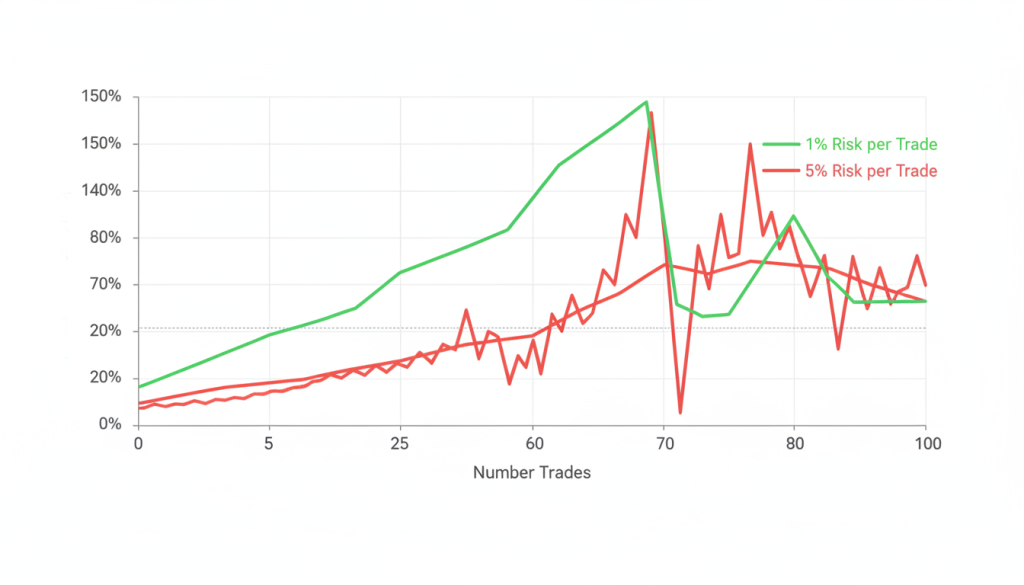
Drawdowns hit harder on synthetic indices. The RNG generates consistent volatility, but “consistent” doesn’t mean “predictable.” A Volatility 75 index will spike violently—that’s the design. Traders expecting forex-like consolidation face rapid account erosion.
The “fairness” question: Deriv’s RNG undergoes third-party auditing to verify randomness [Deriv]. Claims of “internal traders” gaming the system lack evidence. However, all broker trades carry counterparty risk—Deriv is the market maker for synthetic indices, meaning your trade’s opposite side. This isn’t manipulation; it’s structural to how synthetic markets function.
Platform limitations include:
- No interbank liquidity (it’s a simulated market)
- Execution speed tied to broker server processing
- Limited historical data depth for statistical analysis
Risk magnification: Because synthetic indices never close, holding overnight positions extends exposure indefinitely. Weekend gaps don’t exist—but weekend volatility does. A Crash 1000 spike doesn’t care that it’s Sunday morning.
How Traders Interact with Synthetic Markets

Unlike forex where retail order flow minimally impacts price, synthetic index “markets” are entirely Deriv’s construct. Your trade doesn’t move the price—the RNG does. This creates a unique dynamic: trader behavior doesn’t cause volatility; volatility causes trader behavior.
Observable patterns emerge not from the indices themselves, but from collective trader reactions. Heavy clustering around Crash/Boom spike zones suggests retail pattern-seeking behavior, but the RNG doesn’t “respond” to this clusterings. The mathematical fairness holds—but psychological patterns among traders remain exploitable through sentiment analysis.
Volatility remains mechanically consistent. A Volatility 50 index maintains 50% annualized volatility by design [Deriv]. This removes the “volatility regime” analysis required in traditional markets. Your edge shifts from predicting volatility changes to capitalizing on volatility constants.
Actionable Steps for Deriv Synthetic Trading
Step 1: Account selection. Choose Zero Spread for scalping Crash/Boom spikes; choose standard accounts for swing strategies on Volatility indices.
Step 2: Position sizing discipline. Never risk more than 1–2% per trade. Synthetic indices’ 24/7 nature tempts overtrading—your capital doesn’t regenerate as fast as the market generates ticks.
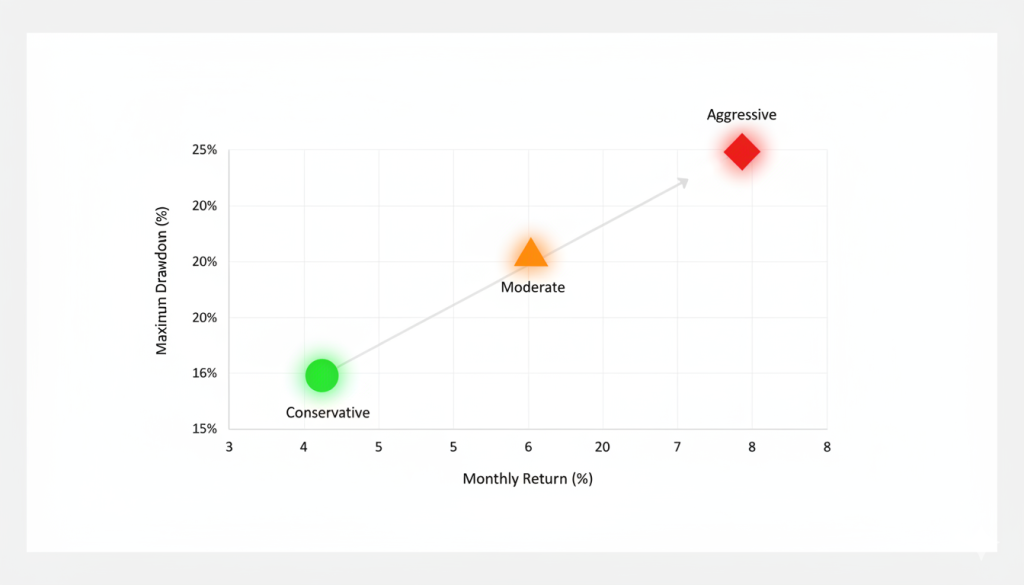
Step 3: Strategy-family matching:
- Conservative: Volatility 10/25 indices with wider stops
- Moderate: Step indices with defined risk increments
- Aggressive: Crash/Boom spike trading with tight stops
Step 4: Realistic return expectations. Profitable traders on synthetic indices target 3–8% monthly returns with 15–25% maximum drawdown tolerance [citation needed]. Avoid claims of “guaranteed” or “consistent” double-digit monthly gains—the mathematics don’t support it.
The Risk Reality
⚠️ Risk Disclaimer: Trading Deriv synthetic indices involves substantial risk of loss. The 24/7 market availability, while convenient, magnifies exposure to rapid drawdowns. Synthetic indices are complex instruments unsuitable for investors unfamiliar with leveraged trading mechanics. Never trade capital you cannot afford to lose entirely. Past RNG-generated performance does not predict future results.
Your Final Takeaway
Deriv synthetic indices offer genuine structural advantages—weekend access, zero spreads, MT5 compatibility—but they’re not “easier” than forex. The RNG ensures fairness, not profitability. Your edge comes from disciplined execution within mathematically consistent volatility parameters, not from outsmarting an algorithm.
Conclusion
Crash & Boom indices aren’t magic. They’re mathematically fair, perpetually available, and structurally different from news-driven markets. Trade them like what they are: algorithmic volatility generators requiring the same risk discipline as traditional instruments—just with fewer excuses for missing opportunities.
Ready to explore synthetic indices with a demo account? Start risk-free testing on Deriv’s MT5 platform before committing capital.
Deriv synthetic indices trade 24/7 with cryptographically verified randomness—offering structural advantages that vanish the moment you abandon position-sizing discipline.”
- Synthetic indices use RNG technology to generate prices independent of real-world market events, ensuring mathematically fair tick generation.
- Zero-spread accounts eliminate bid-ask costs on Deriv synthetic indices, particularly advantageous for high-frequency Crash & Boom spike trading strategies.
- 24/7 market availability includes weekends, but continuous exposure magnifies risk—disciplined traders risk only 1–2% per position regardless of market hours.
FAQs
Sources List
Primary Sources Used
- Deriv Synthetic Indices Overview
https://deriv.com/markets/derived-indices/synthetic-indices - Deriv Zero Spread Account Documentation
https://deriv.com/trading-platforms/deriv-mt5 - Deriv MT5 Platform Documentation
https://deriv.com/trading-platforms/deriv-mt5 - Deriv Crash/Boom Key Information Document (KID)
https://deriv.com/trading-specifications#derived-indices
Secondary/Comparative Sources
- Investopedia: Synthetic Instruments
[Background context for synthetic financial instruments concept]
https://www.investopedia.com/terms/s/synthetic.asp


